
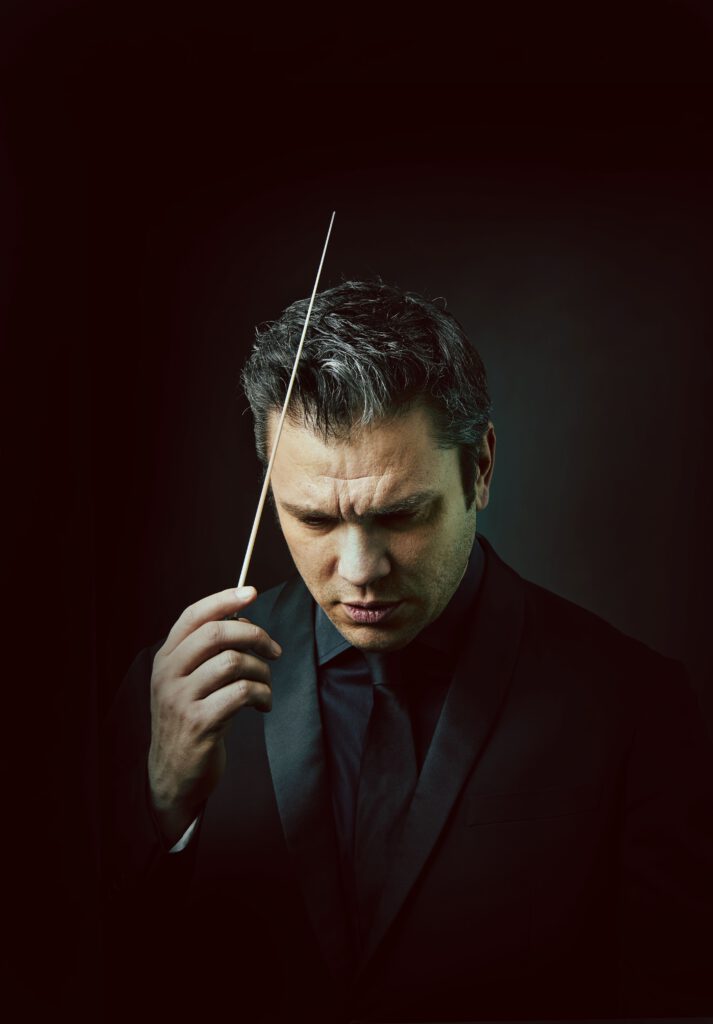
Enrico Calesso
Conductor
– General Management (except Italy) –
Enrico Calesso, born in Treviso, is Music Director at the Teatro Lirico Giuseppe Verdi in Trieste and Resident Guest Conductor at the Landestheater in Linz (Austria). From 2011 to 2025, he was Generalmusikdirektor at the Mainfranken Theater in Würzburg (Germany) and Chefdirigent of the Würzburg Philharmonic Orchestra.
Enrico Calesso has conducted orchestras such as the Gewandhaus Orchester in Leipzig, the Orchestra del Maggio Musicale Fiorentino, the Orchestra del Teatro Regio in Turin, the Orchestra del Teatro La Fenice in Venice, the Orchestra del Teatro Verdi in Trieste, the Orchestra del Teatro Lirico in Cagliari, the Wiener Symphoniker, the Staatsphilharmonie Nürnberg, the Bruckner Orchester Linz, the Orchestra della Svizzera Italiana, the RSO Orchestra in Vienna, the Orchestra Haydn of Bolzano and Trent, the Berner Symphonie-Orchester, the Orchestra del Puccini Festival in Torre del Lago, the Neue Philharmonie Westfalen, the Würzburg Philharmonic Orchestra, the Tiroler Symphonieorchester in Innsbruck, the Orchestra da Camera di Mantova, the Münchner Symphoniker, the Staatskapelle Schwerin, the Norddeutsche Philarmonie, the Jenaer Philharmonie, the Nordwestdeutsche Philarmonie, the Erfurt Philharmonic Orchestra, the Orchestre Symphonique in Mulhouse, and the Symphonic Orchestra in Rzeszów.
A reference interpreter for German, symphonic and contemporary repertoires, in recent years he has conducted works such as Götterdämmerung, Das Rheingold, Tristan und Isolde, Lohengrin, Salome, Der fliegende Holländer, Ariadne auf Naxos, Wozzeck, Die glückliche Hand, Des Teufels Lustschloss.
Richard Strauss’s Elektra holds a central place in his activity; he has conducted the opera multiple times, and, after years of extensive study, personally created two original orchestral renditions (Mainfranken Theater, 2023, and Teatro Verdi Trieste, 2026).
In the symphonic field, he has performed complete cycles of all the symphonies and concertos by Brahms, all of Beethoven’s symphonies, and major symphonies by Haydn, Mozart, Bruckner, and Mahler. In recent years, he has intensified the study and execution of R. Strauss‘ works, especially of the most significant tone poems, the horn and oboe concertos, of the Metamorphosen, and of Der Bürger als Edelmann.
For his musical direction of Götterdämmerung at the Mainfranken Theater in Würzburg, he was nominated as Conductor of the Year in the prestigious 2019 Jahrbuch of the magazine «Opernwelt».
In the same magazine’s 2020 Jahrbuch, he was nominated again—this time in the Production of the Year category—for his highly acclaimed conducting of Rigoletto.
Enrico Calesso has prepared and conducted numerous world premieres of works by major composers, such as G. Battistelli, A. Schreier, G. Stäbler, R. Febel, and C. Ehrenfellner, while also profoundly exploring the interpretation of great 20th-century operatic and symphonic music.
Since 2016, he has been a regular guest at the Gran Teatro La Fenice in Venice, with Il segreto di Susanna (E. Wolf-Ferrari), Agenzia Matrimoniale (R. Hazon), La Traviata, Pinocchio (P. Valtinoni), and Le Baruffe (G. Battistelli). His debut at the Puccini Festival in Torre del Lago (Madama Butterfly, 2020) was a major success with both audiences and critics; he returned there in 2021 for La Bohème and in 2022 for Tosca. From 2011 to 2012, he collaborated with the Bregenz Festival (Austria), conducting over 20 performances of Andrea Chénier. Prior to that, he served as music director of the Klosterneuburg Opera Festival (Vienna) for three seasons, starting in 2008.
For the Teatro Lirico G. Verdi in Trieste, he will conduct Lohengrin and Don Giovanni during the 2026/27 season.
Notable among his recent opera productions are titles such as The Makropulos Case, The Rake’s Progress, Madama Butterfly, La Bohéme, Tosca, Turandot, Gianni Schicchi, Carmen, Lucia di Lammermoor, Otello, Falstaff, Aida, Macbeth, La traviata, Rigoletto, Il Trovatore, La Forza del Destino, La sonnambula, I Capuleti e i Montecchi, Medea, L’Africaine, Les Huguenots, Les Vêpres siciliennes, Eugen Onegin, Nixon in China as well as the ongoing exploration of the works of Mozart and Rossini, featuring various productions of Le nozze di Figaro, Don Giovanni, Così fan tutte, Entführung aus dem Serail, Idomeneo, Die Zauberflöte, Italiana in Algeri, La Cenerentola, Il Barbiere di Siviglia, and Guillaume Tell.
Finally, he also shows significant activity in the Baroque repertoire, with rediscoveries such as Galuppi’s Alessandro nell’Indie and major works like Handel’s Rinaldo and Gluck’s Orfeo, as well as rarely performed titles such as Cherubini’s Ifigenia in Aulide. His repertoire also encompasses masterpieces from other musical genres, including operetta, musicals, and ballet.
Enrico Calesso obtained his piano diploma at the «Benedetto Marcello» Conservatory in Venice under the guidance of Anna Colonna Romano. He subsequently trained as a conductor in Uroš Lajovic’s class at the University of Music in Vienna, graduating with highest honors and distinction and receiving the University’s Würdigungspreis (Award of Excellence). He also obtained a degree in theoretical philosophy with highest honors and distinction from Ca‘ Foscari University in Venice, studying under Professor Emanuele Severino.